


1
Intention
The transparent yes.
2
Intelligence
The beautiful system.
3
Intervention
The conscious change.
4
Integration
The real manifestation.
5
Interaction
The sensible influence.
6
Intemporal
The timeless remembrance.
7
Integrity
The living art of truth.


Creating the way from a painful timeloop to a life of timeless art.

1. INTENTION
Every transformation begins with a quiet yes – a transparent echo of truth beneath all noise. It’s not a push against nor a pull toward, but a still point that allows life to move through you. From here, the right decisions arise on their own – effortless, precise, and true. When intention grows from silence, choice becomes creation, and what’s real begins to reveal its gold.

2. INTELLIGENCE
Your body, your nervous system, and your emotions reveal their beauty – showing that you were always wise and kind, even when it didn’t feel that way. What once appeared chaotic or destructive was simply your own guiding intelligence in creation. Now, seeing the gentle brush of self-love beneath your patterns, you begin to move from survival to surrender.

3. INTERVENTION
Awareness becomes movement, the moment you choose your colors differently, knowing why. You pause where you once pushed, breathe where you once froze, stay present where you once escaped. You use the most beautiful hues to paint over pain and the old attempt to avoid it. Within this new palette, life no longer drowns you, it draws you line by line.

4. INTEGRATION
Avoided pain and fear deepen the wound, for all creation moves through resonance. When you try to rewrite your story, the shadow writes itself even bolder. Integration means turning toward what once felt unbearable, allowing even the darkest chapters to belong to your arc. As you reach this point, pain turns into poetry and happy endings begin to find their way to you.

5. INTERACTION
Often boundaries blur, and empathy becomes the canvas where others paint their needs. Stroke by stroke, you redraw your own frame. You begin to uncover the many layers of other people’s feelings and energies placed onto and into you. You learn to feel what is yours and what is projection or externalization. Influence becomes inspiration, not a loss of identity.

6. INTEMPORAL
Time doesn’t fly away – it circles back to bring understanding. Through ages and generations, a golden current runs beneath it all. What was once left unresolved moves through you, seeking completion; what was once forgotten returns as wisdom. You begin to see that healing is remembrance, not repair – and that even dark ages and dying hopes belong to your picture of time.

7. INTEGRITY
When truth enters the being, calm does not follow – only shattering and shaking. Colors, textures, and structures that once held everything together begin to fade and crumble away, yet you are held within your own canvas, guided through the loosening of the dull, until what remains begins to shine. Wholeness becomes golden – a living art of being real.
swipe to explore all 7 principles

The meaning of
Integraphy is a method that transforms trauma into artful healing and growth.
The name combines two ancient roots – integer, Latin for whole, complete, untouched, and graphy, Greek for to write, to draw, to make visible.
Together they describe the essence of this work: to draw wholeness back into visibility – to let the unseen be seen, the fragmented become form. In Integraphy, we rewrite our inner narratives, but we also paint, trace, and map them. We follow the hidden curves of pain and the recurring patterns of loss until they reveal their quiet order. Once seen, they can be redrawn. What once felt fixed becomes fluid, open to transformation.
Integraphy unites creativity, systemic wisdom, somatic awareness, and the natural bilateral rhythm of the brain – expressed here through artful perception and embodied creation. As the eyes move alongside the hand, the body draws what the mind cannot yet name. It is not about erasing what happened, but about redrawing it – so that every wound begins to reveal its golden lining, and what once was merely endured becomes consciously, beautifully lived.

HOW THIS BEGAN
In the following sections, I share how my personal experience grew into this technique, and how pain and problems turned into purpose.
Integraphy and the 7 principles are what I’ve been shaping, testing, and refining for most of my life. Since I was nine years old, I’ve been searching – relentlessly, curiously, devotedly – to understand how hate, betrayal, loss, and abuse, the darkest parts of being human, could be transformed not only for those who suffer as I did, but for humanity itself. Much of what later became Integraphy first emerged during my teenage years, when I began to intuitively develop the core of this technique without yet knowing what it was.
I tried to keep the long story short – but it’s still a lot. So feel free to scroll through or stay and read the whole journey. Either way is perfectly fine. Either way is perfectly fine. I simply wanted to share it with those who feel called to know more, because somewhere in it, something in you may quietly remember itself.
I’m so glad you’re here,

When I was still a child, I experienced a moment of spontaneous healing – all of a sudden, I stopped a psychotic break that had lasted for weeks, marked by dissociation, paranoia, and depersonalization. I was terrified I would lose my mind forever, unable to reach out for help.
One night, in despair, I screamed to God, to my soul, to everything in between – and then, all at once, it stopped. Something shifted. For a brief moment, I felt reality reassemble inside me – as if a higher intelligence had rearranged the fragments. It was a brief vision of what is possible, though I had no idea how I had done it – and the power of it frightened me so deeply that I tried to forget it ever happened.
When I was thirteen, I fell ill with chronic fatigue syndrome. Confined to bed and isolated for almost four years, I began to research within myself – searching for meaning, for patterns, for a way back to life.
I spent days and nights thinking, reflecting, and talking to myself, as if I could decode the language of my own mind. It became my first form of self-guided therapy – intuitive, strange, but somehow working.
At some point, I began to paint and write what I saw on the inside – images, symbols, and metaphors that seemed to arise from a meta-level of perception, where thought, feeling, and image merged. That inner world became my dialogue partner. It helped me to externalize what I couldn’t yet understand in words – and to keep believing in my healing, even while trapped in a body that felt unbearably heavy, tired, and motionless, filled with diffuse pain in my bones, joints, and head.
Doctors saw little chance, but I knew: I would recover. To hold on to that knowing, I had to see it – to paint my faith into form and overpaint the opinions of others. And slowly, something began to change.
Eventually, by the age of eighteen, I recovered from this illness known as not able to heal.
I went on to study communication design, and it quickly became clear that I had an extraordinary gift – ideas and images came effortlessly, as if I could translate something invisible into form. At only twenty, remarkably young for the field, I became an art director, but soon I knew this wasn’t the purpose of my healing. Selling illusions, however beautifully designed, could not be my path. So, at twenty-two, I left and started my own studio.
When I opened my design studio, I initially worked with lifestyle clients. Yet without actively seeking it, more and more coaches, therapists, and artists found their way to me. I used Integraphy within their branding and vision processes. Until then, I believed Integraphy worked only for me — a private language I had developed to survive and heal. But this growing interest made me wonder whether what had emerged intuitively might be universal after all.
Out of curiosity, I began studying art therapy alongside my work. I encountered valuable perspectives, yet I also sensed its limits. Much of the process remained guided and mediated, often unfolding in group settings, with healing framed as something that happened through another person. From my own experience, I already knew that this structure was not well suited for deep trauma transformation. I wanted a method that strengthened autonomy, inner coherence, and self-trust.
Then I became pregnant.
And the question of whether Integraphy was “only for me” changed entirely.
When I started my design studio, I believed my role was to create clarity and beauty, and I did. Over time, however, I began to notice a quiet pattern. Clients arrived carrying stories most of the world could not hold: neglect, sexual abuse, domestic violence, emotional cruelty, moments of danger and near-death. They had never spoken to anyone, yet they spoke to me. I began to understand something essential. Trauma can ignite grand dreams and collapse them at the same time. Where suffering remains unseen, the value forged through survival stays inaccessible. Without this recognition, that worth cannot be reclaimed, and lasting success cannot follow. No design, strategy, or marketing can compensate for this gap.
This insight led me to develop my branding and purpose concept, Emergent Positioning. It is built on two threads of life: the golden thread, the talents that come naturally, and the scarlet thread, the wounds that repeat themselves with striking consistency. This way of seeing and weaving identity is something you now encounter throughout COR and MATRI.
Around the same time, I worked as a marketing manager for large coaching companies and witnessed something deeply troubling. Methods that claimed to empower were quietly retraumatizing people instead. High-pressure strategies built on bypassing, manifestation framed as another place to fail, identity confusion disguised as mindset work, and even trauma-healing approaches designed to create dependency and endless consumption did not create freedom. They trapped people, emotionally and financially.
Watching this left me uneasy. I knew I could do better. I had helped myself, my children, and many clients already. And yet I resisted turning trauma into my work. I wanted distance, not deeper immersion. I did not want to speak about my experiences anymore or turn lived pain into a product. Eventually, I understood that I could not separate my golden thread from my scarlet one without betraying the truth, my own and that of the people who trusted me.
Integraphy had not entered my life only to support my own healing. It had been forming quietly for years because others needed it too. Golden Linings began the moment I stopped trying to leave trauma behind and accepted that this work had already chosen me long ago.
It was time to share it.
HOW THIS BEGAN
In the following sections, I share how my personal experience grew into this technique, and how pain and problems turned into purpose.
Integraphy and the 7 principles are what I’ve been shaping, testing, and refining for most of my life. Since I was nine years old, I’ve been searching – relentlessly, curiously, devotedly – to understand how hate, betrayal, loss, and abuse, the darkest parts of being human, could be transformed not only for those who suffer as I did, but for humanity itself. Much of what later became Integraphy first emerged during my teenage years, when I began to intuitively develop the core of this technique without yet knowing what it was.
I tried to keep the long story short – but it’s still a lot. So feel free to scroll through or stay and read the whole journey. Either way is perfectly fine. I simply wanted to share it with those who feel called to know more, because somewhere in it, something in you may quietly remember itself.
I’m so glad you’re here,

When I was still a child, I experienced a moment of spontaneous healing – all of a sudden, I stopped a psychotic break that had lasted for weeks, marked by dissociation, paranoia, and depersonalization. I was terrified I would lose my mind forever, unable to reach out for help.
One night, in despair, I screamed to God, to my soul, to everything in between – and then, all at once, it stopped. Something shifted. For a brief moment, I felt reality reassemble inside me – as if a higher intelligence had rearranged the fragments. It was a brief vision of what is possible, though I had no idea how I had done it – and the power of it frightened me so deeply that I tried to forget it ever happened.
When I was thirteen, I fell ill with chronic fatigue syndrome. Confined to bed and isolated for almost four years, I began to research within myself – searching for meaning, for patterns, for a way back to life.
I spent days and nights thinking, reflecting, and talking to myself, as if I could decode the language of my own mind. It became my first form of self-guided therapy – intuitive, strange, but somehow working.
At some point, I began to paint and write what I saw on the inside – images, symbols, and metaphors that seemed to arise from a meta-level of perception, where thought, feeling, and image merged. That inner world became my dialogue partner. It helped me to externalize what I couldn’t yet understand in words – and to keep believing in my healing, even while trapped in a body that felt unbearably heavy, tired, and motionless, filled with diffuse pain in my bones, joints, and head.
Doctors saw little chance, but I knew: I would recover. To hold on to that knowing, I had to see it – to paint my faith into form and overpaint the opinions of others. And slowly, something began to change.
Eventually, by the age of eighteen, I recovered from this illness known as not able to heal.
I went on to study communication design, and it quickly became clear that I had an extraordinary gift – ideas and images came effortlessly, as if I could translate something invisible into form. At only twenty, remarkably young for the field, I became an art director, but soon I knew this wasn’t the purpose of my healing. Selling illusions, however beautifully designed, could not be my path. So, at twenty-two, I left and started my own studio.
Coming soon — when the story is ready to be told.
When I started my design studio, I believed my role was to create clarity and beauty, and I did. Over time, however, I began to notice a quiet pattern. Clients arrived carrying stories most of the world could not hold: neglect, sexual abuse, domestic violence, emotional cruelty, moments of danger and near-death. They had never spoken to anyone, yet they spoke to me. I began to understand something essential. Trauma can ignite grand dreams and collapse them at the same time. Where suffering remains unseen, the value forged through survival stays inaccessible. Without this recognition, that worth cannot be reclaimed, and lasting success cannot follow. No design, strategy, or marketing can compensate for this gap.
This insight led me to develop my branding and purpose concept, Emergent Positioning. It is built on two threads of life: the golden thread, the talents that come naturally, and the scarlet thread, the wounds that repeat themselves with striking consistency. This way of seeing and weaving identity is something you now encounter throughout COR and MATRI.
Around the same time, I worked as a marketing manager for large coaching companies and witnessed something deeply troubling. Methods that claimed to empower were quietly retraumatizing people instead. High-pressure strategies built on bypassing, manifestation framed as another place to fail, identity confusion disguised as mindset work, and even trauma-healing approaches designed to create dependency and endless consumption did not create freedom. They trapped people, emotionally and financially.
Watching this left me uneasy. I knew I could do better. I had helped myself, my children, and many clients already. And yet I resisted turning trauma into my work. I wanted distance, not deeper immersion. I did not want to speak about my experiences anymore or turn lived pain into a product. Eventually, I understood that I could not separate my golden thread from my scarlet one without betraying the truth, my own and that of the people who trusted me.
Integraphy had not entered my life only to support my own healing. It had been forming quietly for years because others needed it too. Golden Linings began the moment I stopped trying to leave trauma behind and accepted that this work had already chosen me long ago.
It was time to share it.
PROGRAMS
THE EXPLORATION
You’ve carried what was never yours, shaping your life around other people’s needs, pain, and purpose. Now you sense what truly wants to live through you, and why the cruel choose you. As you reclaim what is yours and release what is not, your real path begins to pulse again. Your talents you used for survival are now free, their worth finally yours.
THE DESCENSION
Family shapes us in ways both tender and painful. Within its patterns lie the deepest wounds – and the greatest potential for healing. When we stop carrying what was never ours and allow responsibility to return to its rightful roots, the ground becomes fertile again. From that soil, calm, strength, and abundance can finally grow.
THE CONNECTION
Love meant confusion. You were idealized, used, or silenced – caught in cycles of lovebombing and devaluation that blurred the line between good and control. Yet from every heartbreak, a golden lining emerged. Recognizing this gold makes old patterns clear and your worth reclaimed. Love becomes mutual, and growth feels safe.
THE LIBERATION
The pain that once defined you now reveals your purpose. As old patterns fall away, fear may rise – because freedom can feel less safe than survival. Yet with every breath, you begin to trust the quiet truth that has lived within you all along. And then, a new self takes form: rooted in clarity and free to embody your true essence.

FEEDBACK
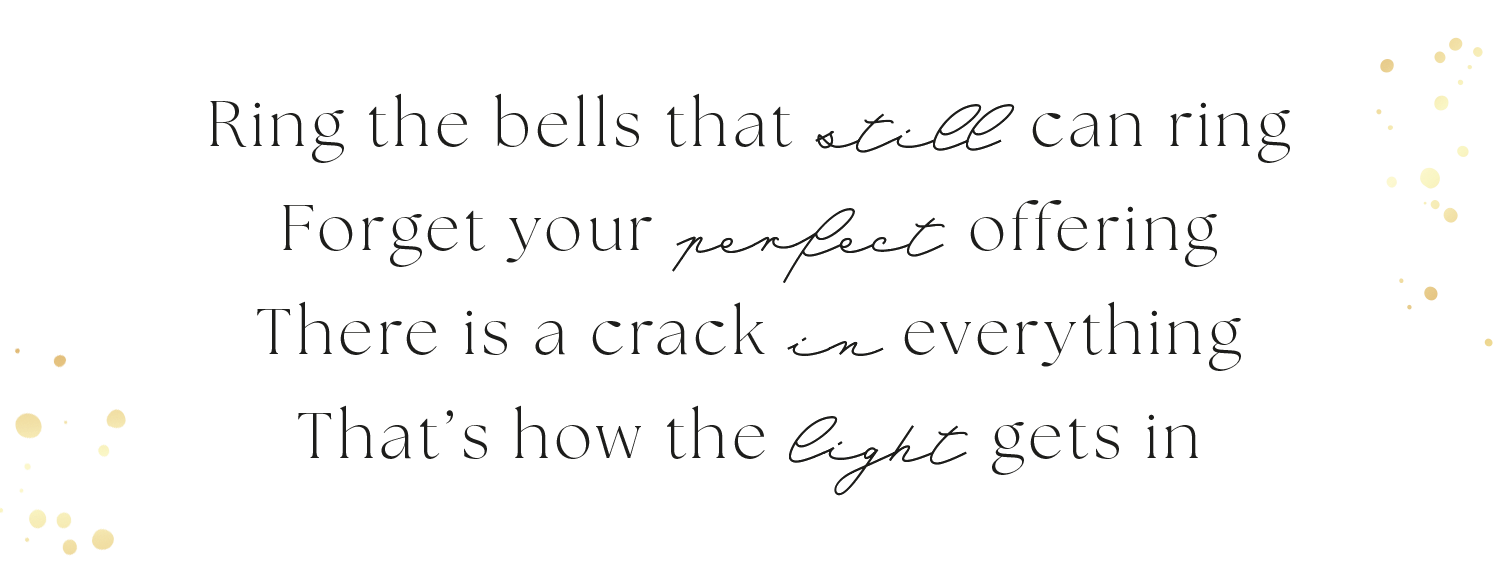
Leonard Cohen
